

By Brian Massie, A Watchman on the Wall
Thanks to Greg Lawson of the Ohio Buckeye Institute for sending this article to us. As we continue to “pull back the curtain” on the spending by the State legislators, we continue to uncover lies, deceptions and betrayals.
The Buckeye Institute: “Shadow Budget” Accounts for More Than Half of Ohio’s $153 Billion Budget
January 27, 2021
Columbus, OH – On Wednesday, The Buckeye Institute released a new policy brief, Beware the Shadow Budget: Ohio Spends More than Many Think, which reveals a full picture of state government spending and is critical to understand as Ohio begins to debate its next biennial budget.
“Ohio’s biennial budget process is about to begin—the first budget planned during the COVID-19 pandemic and one that will require sound fiscal strategies to overcome the unique challenges the pandemic presents,” said Greg R. Lawson, research fellow at The Buckeye Institute and the author of Beware the Shadow Budget. “Such strategies require a complete and honest assessment of state spending, which can only be achieved by shinning a light on Ohio’s ‘shadow budget’.”
In his brief, Lawson points out that Ohio’s total expenditures will cost taxpayers more than $153 billion—more than twice the $69 billion dollar figure often cited as “Ohio’s budget.”
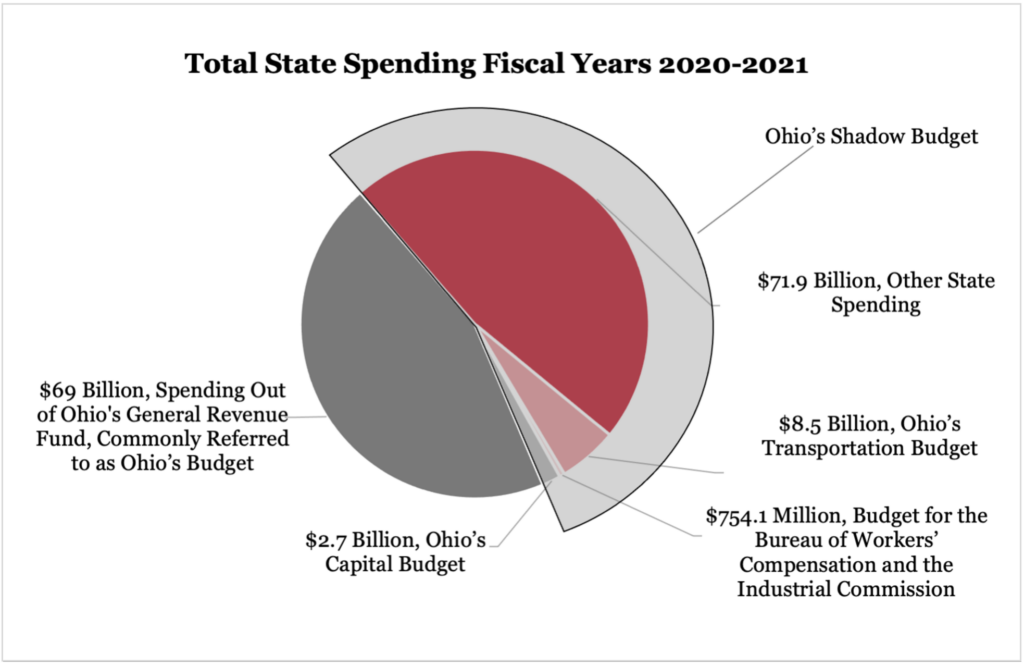
Lawson urged lawmakers and the media to shed more light on Ohio’s “shadow budget,” including:
- Enhance transparency initiatives, such as Ohio Checkbook;
- Strengthen the Statutory Appropriation Limitation;
- Tie non-emergency spending growth to state population growth and inflation rates; and
- Report on all of the state’s spending, not just the General Revenue Fund.
“Suggesting that ‘Ohio’s budget’ was a mere $69 billion is grossly misleading and makes it difficult for voters and taxpayers to accurately assess the size, scope, and cost of their government,” Lawson wrote. “And keeping taxpayers in the dark about government spending undermines accountability for state officials and policymakers.”
Editorial Comments by Brian Massie:
As we have stated many times the State of Ohio does not have a revenue generation problem, they have a spending problem. We would add another problem: “deceiving the voters of Ohio”. That appears to be their forte.
Eliminating property taxes for seniors reaching 65 years of age would cost $3 billion. However, state legislators and state officials do not believe in giving seniors a break. They would rather have seniors, if they cannot afford their property taxes, to sell their home and move into an apartment. That will also help with the housing shortage. Using the 2021 spending as a guide, that means eliminating property taxes for seniors would take less than 2% of the budget. [$3 / $153]



Categories: Uncategorized