
Updated May 9, 2026…explaining MAID
By Brian Massie, A Watchman on the Wall
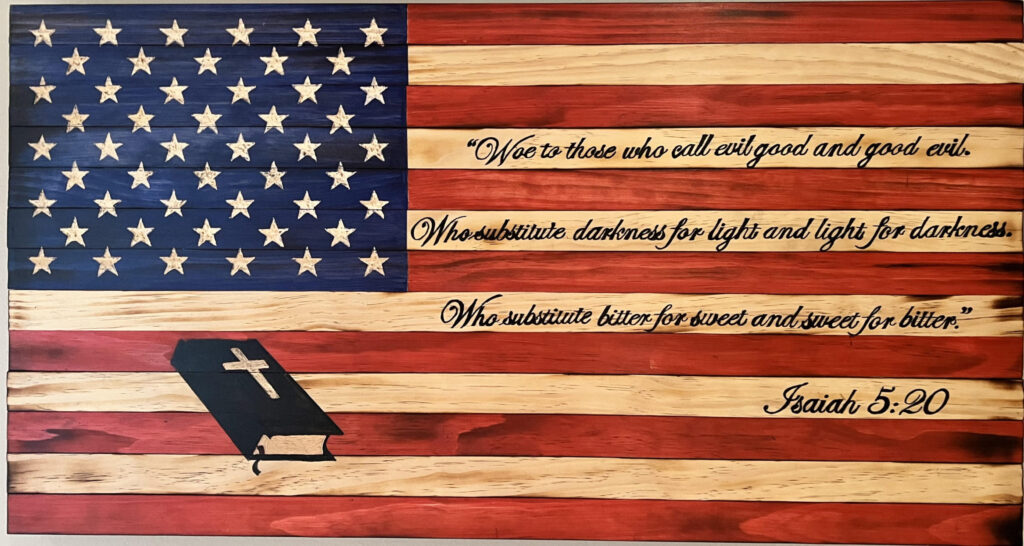
I continue to see reminders of what Isaiah 5:20 was warning us about.
Found in the book of Isaiah, this verse is part of a series of “woes” meant for the nation of Judah, highlighting the dangers of moral relativism, corruption, and the willful distortion of truth.
Key Themes of Isaiah 5:20
- Reversal of Morality: The verse condemns those who consciously mislabel wicked actions as virtuous and righteous actions as evil.
- Moral Confusion: It warns against replacing divine truth (“light”) with deception (“darkness”).
- Warning of Judgment: The “woe” is an expression of imminent judgment from God against those who abandon His standards.
Contextual Understanding
Isaiah wrote this during a time of intense moral and spiritual decay in the Kingdom of Judah. It serves as a critique of a society that has lost its moral compass, often desensitizing itself to sin and attacking righteousness.
https://www.prophecynewswatch.com/article.cfm?recent_news_id=9931
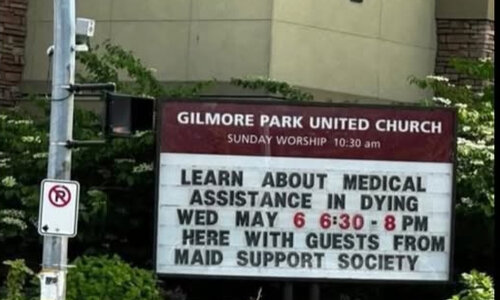
Scandalous: Why Is A Church Promoting Assisted Suicide?
When a Church Forgets What Life Is
Christianity, at its core, is built on the sacredness of life. From Genesis to Revelation, life is not treated as disposable, conditional, or subject to personal convenience. It is God-given, God-breathed, and God-owned.
So how does a church arrive at a place where it invites someone to advocate for ending that life?
MAID in Canada stands for Medical Assistance in Dying and is often wrapped in soft language–“compassion,” “dignity,” “choice.” But strip away the branding, and the reality is stark: it is the intentional ending of a human life. There is no theological framework within historic Christianity that can reconcile this with the commandment, “You shall not murder,” or with the belief that suffering, while painful, is not meaningless.
Yet here we are.
A congregation not merely tolerating this worldview, but platforming it.
A Nation Sliding Further Down the Slope
Canada’s expansion of MAID is not theoretical–it is measurable, accelerating, and deeply alarming.
Since legalization in 2016, the number of Canadians who have died through assisted suicide has risen dramatically year after year, placing Canada on track to become the first modern nation to surpass 100,000 euthanasia deaths in less than a decade.
The scale of the program is staggering. In 2024 alone, 16,499 Canadians died through MAiD–about 5.1 percent of all deaths in the country, meaning roughly one out of every twenty deaths in Canada now occurs through assisted suicide.
At the current pace–about 45 assisted deaths every day–Canada is expected to pass the 100,000 mark around the June anniversary of the law’s passage.
Let that settle in.
And the push is not slowing down. Advocates continue to push for broader eligibility: not just terminal illness, but chronic conditions. Not just physical suffering, but mental health struggles. Not just adults, but–eventually–consenting minors.
This is not a stable endpoint. It is a moving line.
And when a church begins hosting conversations that normalize this trajectory, it is no longer standing apart from the culture–it is actively participating in its moral collapse.
Even the Faithful Are Not Spared
Perhaps one of the most chilling recent accounts comes from a Catholic priest in Canada who revealed he was offered MAID–not once, but twice–despite clearly stating his identity as a priest and his moral opposition to such actions.
Think about that.
A man devoted to preserving life, to shepherding souls, to upholding the sanctity of God’s creation–offered death as a solution.
Twice.
If that does not reveal how deeply embedded this mindset has become within the medical system, what will?
And if the broader culture is drifting this far, the role of the church should be to stand firm–not to drift alongside it.
The United Church of Canada: A Long Pattern
To understand how this moment became possible, you have to look at the broader theological direction of the United Church of Canada.
This is not an isolated incident. It is the fruit of decades of doctrinal drift.
The denomination has long embraced positions that depart from historic Christian teaching, including:
– Support for abortion rights, framing it as a matter of personal autonomy rather than moral gravity.
– Full affirmation of LGBTQ+ identities and same-sex marriage, including ordination of openly gay clergy.
– Active promotion of transgender ideology, including affirming gender transition as compatible with faith.
– Rejection of biblical inerrancy, treating Scripture as a human document open to reinterpretation rather than the authoritative Word of God.
At each step, the justification has been similar: compassion, inclusion, modern relevance.
But taken together, the pattern is unmistakable.
When a church begins to redefine Scripture, it eventually redefines sin. When it redefines sin, it redefines morality. And when morality becomes fluid, nearly anything can be justified–including, it seems, the endorsement of assisted suicide.
A Social Club Wearing Sacred Clothing
What remains, then, is something that resembles Christianity in form but not in substance.
There are hymns, sermons, and community gatherings. There is language about love and justice. There is a desire to “do good” and be seen as compassionate.
But without a firm foundation in biblical truth, it becomes something else entirely–a spiritualized social club, offering emotional comfort without moral clarity.
It is a version of Christianity that asks nothing, challenges nothing, and ultimately stands for nothing.
And that is precisely why it can host an event promoting something as serious as assisted suicide without recognizing the contradiction.
The Deeper Danger
The real danger is not just one canceled event in one Canadian church.
It is the normalization of a worldview where life is negotiable.
Where suffering is something to eliminate rather than endure.
Where death is presented not as an enemy, but as a solution.
And most troubling of all–where the church, which should be the last line of moral resistance, becomes a participant in that narrative.
A Line That Must Be Drawn
There are moments in history when institutions reveal what they truly believe–not through statements, but through actions.
This was one of those moments.
A church chose to invite a speaker to promote assisted suicide. Only public backlash stopped it. Not internal conviction. Not theological clarity. External pressure.
That should concern anyone who still believes the church is meant to be a light in the darkness–not a mirror reflecting it.
Because if the place that is supposed to defend life begins to question its value, then the question is no longer about one event.
It is about how far we have already fallen–and how much further we are willing to go.
ADVERTISEMENTS

Categories: Community Activism, Contributors