

By Brian Massie, A Watchman on the Wall
Thanks to the Lake County patriots for sending us this Cleveland.com article. My editorial comments are at the end of the article.
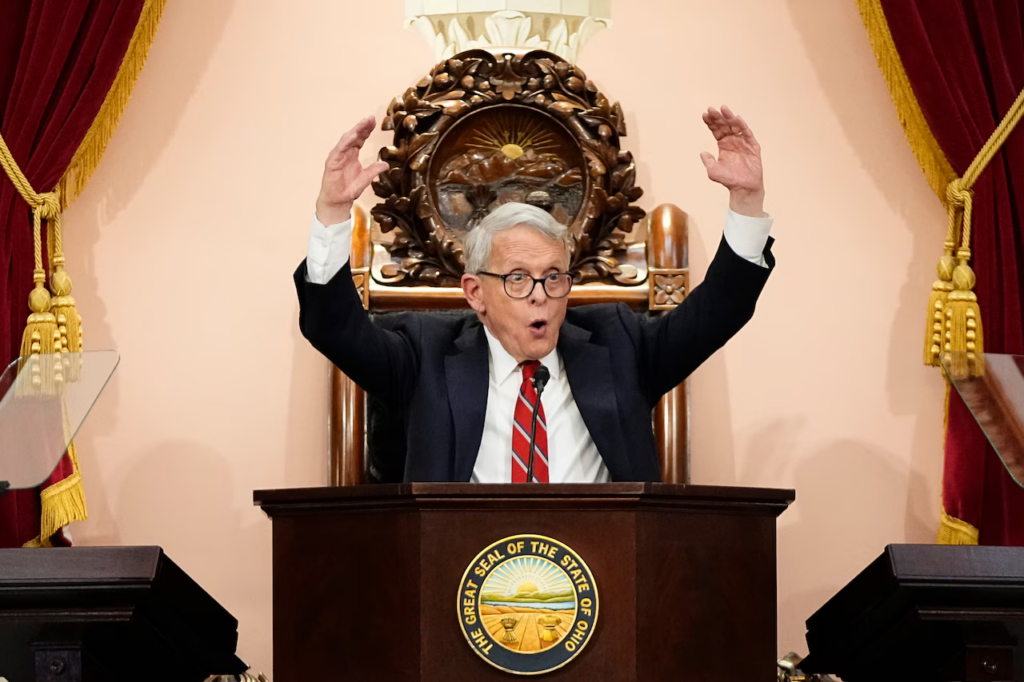
Ohio Gov. Mike DeWine motions O-H as he concludes his final State of the State address in March. A preliminary report from DeWine’s Office of Budget and Management estimates Ohio has collected $1.2 billion more than expected this fiscal year.Adam Cairns/Columbus Dispatch
By
COLUMBUS, Ohio — Ohio has collected $1.2 billion more than expected this fiscal year, according to a preliminary report from the Office of Budget and Management. And lawmakers, lobbyists, and advocacy groups already have plenty of ideas for what to do with it.
Some want tax relief to help Ohioans cope with rising gas prices. Others argue the money should go toward long-delayed Medicaid payments, public education or additional income tax cuts.
The unexpected revenue boost is setting up a familiar Statehouse debate: return the money, spend it or save it for a rainy day.
Why did Ohio collect more?
Setting a state budget is less like planning around a fixed salary and more like trying to predict how busy a restaurant will be months in advance.
Sales taxes rise when people spend more. Income tax collections rise when wages or business profits increase. Gas tax revenue fluctuates depending on how much people drive.
Personal income tax accounts for 60% of the “positive revenue variance,” according to the OBM report. Income tax collections are running nearly $699 million above estimates for the fiscal year, while sales tax collections are also outperforming expectations.
Sen. Bill Blessing, a Cincinnati area Republican, said some of Ohio’s extra collections come from inflation.
“Unfortunately, inflation inflates our revenues, particularly sales tax,” Blessing said. “In order to afford to live and work in Ohio, employers have to increase wages. I’ll bet real wages have been stagnant at best.”
Spend more on schools
Blessing’s solution is to put the extra billion dollars into public school funding.
Cut property taxes
Rep. Thomas Hall said the extra money could help older Ohioans stay in their homes.
The Butler County Republican suggested dedicating a quarter of the surplus to expanding Ohio’s homestead exemption, a property tax break for eligible seniors and disabled homeowners.
Hall said the program’s income limits and tax reduction amounts haven’t changed since 2009, even as home values and property tax bills climbed.
His bipartisan proposal, House Bill 103, would update those amounts for 2026.
Senate Minority Leader Nickie Antonio, a Cleveland Democrat, said she supports the idea.
Antonio also suggested lawmakers could use the additional revenue to increase school funding or expand access to publicly funded child care by raising income eligibility limits for assistance programs.
Bring down gas prices
Some lawmakers see the extra revenue as a way to lower gas prices.
Governors in Kentucky, Indiana, and Georgia have implemented temporary “gas tax holidays” that paused part of their state gas taxes to reduce prices at the pump.
Rep. Ty Mathews, a Hancock County Republican, has proposed a three-month, 50% reduction in the state’s 38.5-cent-per-gallon gas tax.
Mathews acknowledged the proposal would not solve the global forces driving oil prices higher, but “this is something we actually do have a little bit of say in.”
Pay outstanding obligations
Another idea is to use the money to pay bills the state already owes.
Last year, the Ohio Supreme Court unanimously ruled that the state underpaid nursing homes that care for Medicaid patients. The court ordered Ohio to recalculate and issue the missing funds.
In court filings, Ohio Medicaid estimated complying with the ruling could cost roughly $285 million more per year than lawmakers intended.
Pete Van Runkle, a lobbyist and former head of the Ohio Health Care Association, wrote in a LinkedIn post that the stronger-than-expected revenues undercut concerns about how the state would pay for the court-ordered funding.
“This means the state doesn’t need to touch the Medicaid rainy day fund to pay Ohio’s skilled nursing facilities the legally required quality incentive payments it has been withholding for nearly three years,” Van Runkle said. “The state has more than enough money.”
Save it
Senate Finance Chair Jerry Cirino, a Lake County Republican, said the “most prudent” option is to hold onto the money until the end of the current two-year budget cycle in 2027.
“It’s great that revenues are coming in above expectations,” Cirino said, “but we don’t know whether that’s going to continue.”
Cirino pointed to potential future Medicaid costs as one reason for caution.
Under changes approved by Congress, states could lose federal Medicaid dollars if they fail to keep error rates below certain thresholds. Errors can include paperwork and eligibility mistakes—not just fraud.
“I think this rush to spend this money like we just discovered it under our mattress is a mistake,” Cirino said.
Editorial Comments by Brian Massie, A Watchman on the Wall

It is not surprising that Comrade Jerry C RINO does not even think about giving money back to the taxpayers. When he can make the statement: “If seniors cannot afford their property taxes, they should sell their homes and move into an apartment”, it is obvious that he does not care about the citizens of Ohio. It gives you the true measure of the man.
Comrade C RINO does not even worry about the fraud, waste and abuse of taxpayers’ money being exposed in Franklin County. He must ascribe to Governor DeWine’s thinking that fraud, waste and abuse is just a cost of doing business in Ohio.
Power tends to corrupt, and absolute power corrupts absolutely. Comrade Jerry C RINO would not hesitate to kick an average citizen out of a meeting, just to show his power.
Here is Comrade Jerry C RINO declaring war on we the people:
ANY TAX CAUSING A CITIZEN TO BECOME HOMELESS IS IMMORAL!


Categories: State of Ohio