
By Brian Massie, A Watchman on the Wall
We have done some inquiries on the local government funds and what happened when former Governor Kasich made drastic cuts to local funding.
Governor John Kasich and Republican lawmakers significantly reduced the Local Government Fund (LGF) starting in 2011 as part of a strategy to address a major state budget deficit and shift Ohio’s fiscal priorities toward state-level tax cuts.
The primary reasons for these cuts included:
- Addressing an $8 Billion Budget Shortfall: Upon taking office in 2011, Kasich faced a projected $8 billion revenue gap. Reducing the LGF by approximately 50% over two years helped the state balance its budget without increasing state-level taxes.
- Funding State Income Tax Cuts: The administration sought to reduce state income tax rates to stimulate economic growth. By retaining more tax revenue at the state level instead of sharing it with municipalities, they were able to implement significant income tax cuts beginning in 2013.
- Encouraging Local Efficiency: Budget Director Timothy Keen and Gov. Kasich argued that local governments had other revenue sources, such as local income taxes, and should become more “efficient” by consolidating services like police, fire, and trash collection with neighboring communities.
- Prioritizing Other State Spending: The administration chose to prioritize state dollars for other areas, such as schools, higher education, and services for the developmentally disabled, rather than general revenue sharing with cities.
- Eliminating One-Time Funding Reliance: The 2011 budget aimed to eliminate the state’s reliance on one-time federal stimulus money, which had been used previously to bridge budget gaps.
Scope of the Reductions
In addition to the 50% cut to the LGF, the Kasich administration implemented other policies that further reduced local revenues:
- Elimination of the Estate Tax: This tax, 80% of which went to local communities, was abolished in 2013 because lawmakers viewed it as “bad policy” that drove wealthy residents out of the state.
- Phase-out of Tax Reimbursements: The state accelerated the phase-out of reimbursements originally intended to compensate local governments for the 2005 elimination of local property taxes on business machinery and inventory
What were the consequences of these cuts for Ohio municipalities?
The cuts to the Local Government Fund (LGF) and other state-level tax changes led to a multi-billion dollar revenue loss for Ohio municipalities, fundamentally altering how local services are funded and delivered. By 2017, Ohio’s counties, cities, and townships had approximately $1 billion less annually than they did in 2010.
The consequences for Ohio municipalities include:
1. Reduction in Public Services
Municipalities were forced to scale back essential services due to the sudden loss of flexible general fund revenue:
- Public Safety: Cities like Cincinnati faced potential layoffs of hundreds of police officers and firefighters. Many communities saw thinning ranks in emergency services and slower response times.
- Infrastructure Maintenance: Street lighting was dimmed or eliminated in some areas, and road and bridge repairs were frequently delayed or halted.
- Quality of Life: Many municipalities shuttered recreation centers, reduced pool hours, and canceled community events like festivals and fireworks.
2. Implementation of New Fees
To offset state-level cuts, many cities shifted the financial burden directly to residents through new or increased “user fees”:
- Garbage and Recycling: Cities such as Toledo, Dayton, and Parma introduced or increased garbage collection fees.
- Emergency Services: Akron raised ambulance fees to cover budget gaps.
- Other Fees: Increases were common for parking meters, court systems, rental fees, and recreational activities. These regressive fees often impacted low-income residents more heavily than the original tax-based funding.
3. Erosion of Health and Human Services
Cuts to tax reimbursements severely impacted local levies that funded critical social safety nets:
- Mental Health and Addiction: Local funding for mental health and addiction treatment was strained just as the opioid epidemic intensified.
- Senior and Children’s Services: Programs like Meals on Wheels and child protective services saw their primary funding sources (voter-approved levies) undermined by the phase-out of state reimbursements.
4. Regionalization and Privatization
Governor Kasich’s push for “efficiency” led to structural changes in local governance:
- Consolidation: Communities increasingly regionalized services such as 911 dispatch, public health departments, jails, and water/sewer billing.
- Privatization: Some municipalities moved toward privatizing public assets and services—including trash collection and even certain park operations—to reduce immediate payroll co

Here is the answer that we were looking for – Here is the deception played on the taxpayers.
5. Increased Reliance on Local Levies
With less support from the state, municipalities and school districts became more dependent on passing local property and income tax levies. However, this led to a “vicious cycle” where the state also curtailed property tax relief programs (like the 10% and 2.5% rollbacks) for new levies, making it more expensive for local voters to approve them.
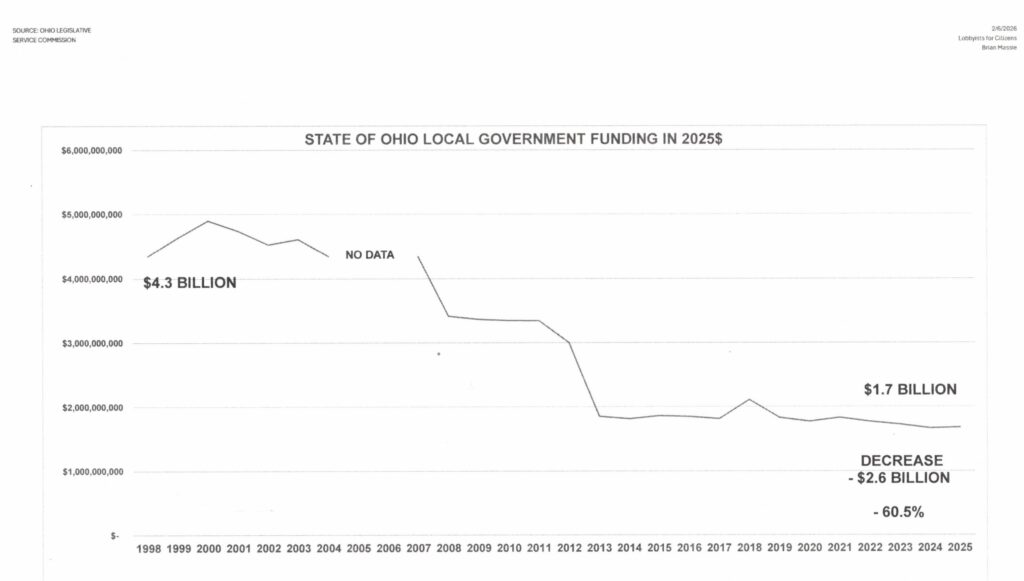
Here is a chart we made showing the drop in local government funds. To remove the impact of inflation, we translated all years into 2025 dollars. It is obvious that this is one source of the problem requiring increased local taxation. State legislators starved the local communities. It is only fitting that we the people “starve the beast” and make the state legislators abide by their oath of office.
Did any Ohio municipalities successfully push back against these cuts?
While Ohio municipalities and local advocacy groups engaged in sustained legal and political pushback against the Kasich-era cuts, they were largely unsuccessful in restoring the Local Government Fund (LGF) to its pre-2011 levels. Most efforts resulted in small, targeted concessions rather than a reversal of the core policy.
1. Legal Challenges (Home Rule Battles)
Municipalities primarily used the Home Rule Amendment of the Ohio Constitution to argue that the state was overstepping its authority.
- Centralized Tax Collection: Nearly 200 cities, led by a coalition including Columbus, Cleveland, and Cincinnati, sued the state over provisions in the 2017 budget that allowed businesses to file municipal net-profit taxes through the state instead of local offices. The Ohio Supreme Court ultimately sided with the state, ruling that the legislature has the power to “restrict” local taxation.
- Traffic Camera Penalties: Cities like Newburgh Heights challenged a state law that reduced a municipality’s LGF share by the exact amount they collected in traffic camera fines. In 2022, the Ohio Supreme Court ruled this “setoff” was constitutional, effectively neutralizing the cities’ ability to use cameras for revenue.
[We wonder if the City of Willoughby Hills has had their LGF share reduced by massive amounts of traffic camera fines they get every year? Need to follow-up with that issue.]
2. Legislative Lobbying and Coalitions
Local leaders formed new alliances to increase their political leverage in Columbus.
- Ohio Mayors Alliance: Formed in 2016, this bipartisan coalition of mayors from Ohio’s 30 largest cities lobbied for a “reinvestment” in local infrastructure and the opioid crisis. While they secured some dedicated funding for specific issues (like the opioid epidemic), they did not succeed in restoring the general LGF percentage.
- Small Successes for Townships: In 2014, a Senate-passed bill earmarked $10 million specifically for Ohio’s townships, which had been hit particularly hard. However, this bill did nothing to restore funding for cities and villages.
3. “Hold-Harmless” Provisions
During the initial rollout of the cuts, some rural pushback led to a temporary safety net:
- County Floor: About a quarter of Ohio’s counties were shielded by a “hold-harmless” provision that established a minimum floor of $750,000 for annual county LGF distributions, preventing smaller counties from losing even more than the 50% baseline cut.
4. Recent Incremental Progress
In the years following Kasich’s departure, the state legislature made minor adjustments, but funding remains far below 2010 levels:
- Minor Percentage Increases: In the 2020-2021 budget, the General Assembly increased the LGF share of the state’s General Revenue Fund (GRF) from 1.66% to 1.68%, though it has fluctuated around these lows ever since.
- Local Resolutions: Municipalities like Lancaster and Cheviot continue to pass formal resolutions (as recently as 2023) urging the Governor and General Assembly to restore the LGF to the pre-recession level of 3.68%.
ADVERTISEMENTS

Categories: Community Activism, Real Estate Taxes