

By Brian Massie, A Watchman on the Wall
Thanks to a Lake County patriot for sending this lengthy article to us on the perils of data centers. As I read the article, I wondered how many data centers can the natural resources of the state of Ohio handle and still have a functioning society where people can exist and have the inalienable rights detailed in the Ohio constitution.
We currently have approximately 200 data centers in Ohio. Can we handle 2,000? How about 20,000? Is there an upper limit, or will our legislators continue to support the donor class over the average citizens of Ohio?
“All men are, by nature, free and independent, and have certain inalienable rights, among which are those of enjoying and defending life and liberty, acquiring, possessing, and protecting property, and seeking and obtaining happiness and safety.”…Article 1, Section 1 Inalienable Rights…Ohio Constitution
We have provided some excerpts of the article.
They Took the Water, the Power, and the Land First — Then the Data Centers Became More Important Than the People Living Beside Them
May 15, 2026
https://madgewaggy.blogspot.com/2026/05/they-took-water-power-and-land-first.html
Editor’s Note
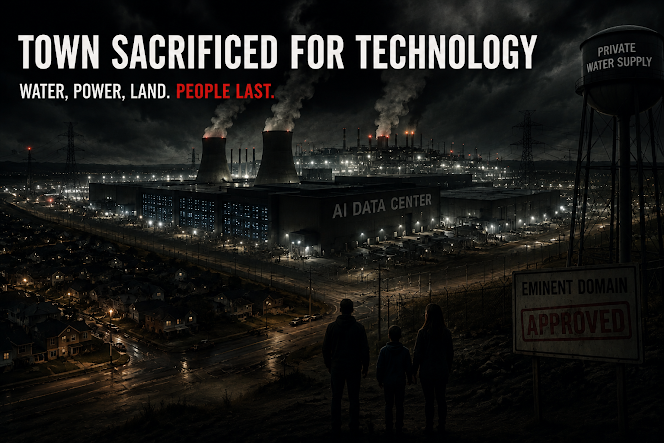
This investigative narrative examines the expanding physical footprint of AI infrastructure and the societal risks that emerge when computational systems begin to depend on the same essentials as human communities.
THE HUM THAT NEVER STOPS
Nobody remembers when the sound began.
Residents describe it differently. Some say it is like distant traffic that never passes. Others compare it to an aircraft that never lands. A few say it feels biological, like standing too close to a sleeping animal large enough to crush a house without noticing. The hum sits beneath conversation, beneath sleep, beneath thought. It is constant, low, and mechanical, and after a few weeks the mind stops trying to locate its source because the source is now part of the landscape.
The building that produces it has no windows.
It has fences, cameras, warning signs, and a perimeter that feels less like private property and more like a restricted zone. Trucks arrive at night carrying equipment that is never explained to locals. Floodlights remain on through fog and rain. Steam rises from cooling stacks even in winter, as if the structure itself is overheating from something happening inside.
On paper, it is called a data center.
In practice, it looks like an industrial organ that has been inserted into a living community.
What most people do not realize at first is that the building is not there because of the town. The town is now there because of the building.
The Deep State sat back and let it happen… You’ll understand why they want this buried!
A Different Kind of Industrial Presence
Factories of the past produced visible goods. Refineries produced fuel. Power plants produced electricity. Their outputs were tangible, their purposes clear. The new structures rising at the edges of cities and rural zones produce something invisible yet treated as more essential than either food or fuel: computation.
These facilities draw enormous, uninterrupted electricity loads measured in tens or hundreds of megawatts. They require continuous water circulation for cooling systems that prevent servers from overheating. They are placed near substations, aquifers, and fiber backbones not because people live there, but because the land itself offers the shortest path between energy, water, and network.
That positioning changes the value of everything around them.
Land that once held homes becomes “strategic.” Water once used for agriculture becomes “allocated.” Power once distributed to neighborhoods becomes “contracted.”
These are administrative words. They do not sound violent. They do not need to.
When Infrastructure Becomes Priority
In multiple regions known for hyperscale computing expansion, utility filings and environmental reviews show a consistent pattern: data centers negotiating long-term guaranteed access to electricity and water at volumes comparable to entire districts. During periods of drought or grid stress, these agreements remain legally binding because they were signed under economic development frameworks years earlier.
Residents notice the consequences in subtle ways.
Electricity prices rise. Water restrictions become seasonal. Zoning boards approve road expansions and utility corridors that cut through neighborhoods. Property taxes climb as land values shift due to industrial demand. Community meetings are held where decisions appear already finalized.
No confrontation occurs. No alarms sound. There is only the slow realization that something larger than the community’s needs has moved into the hierarchy of importance.
The Language of Historical Warning
The political scientist R. J. Rummel used the term democide to describe the killing of people by governments through systemic power, policy, and neglect rather than overt violence. Genocide, more narrowly defined, involves destruction based on identity. Both begin not with aggression but with control over essentials.
Water. Energy. Land.
Today, artificial intelligence requires all three at industrial scale.
This does not imply intent. It reveals a structure that history has shown to be dangerous when left without strict oversight.
The Physical Appetite of Intelligence
A single large facility can circulate millions of gallons of water daily for cooling, depending on climate and design. Backup diesel generators sit ready to power the complex independently if the grid fails. High-voltage substations feed constant energy into server halls that cannot afford interruption without severe economic penalties.
During heat waves or drought conditions, these demands collide with community limits. The contracts, however, were written when scarcity was theoretical.
Now scarcity is seasonal.
The legal framework remains unchanged.
The Subtle Reordering of Importance
Imagine a heat emergency where the grid is overloaded. Rolling blackouts become an option. Who loses power first: residential districts or facilities protected by industrial continuity agreements?
Imagine severe drought where water extraction must be reduced. Who reduces usage first: households or installations holding multi-year permits negotiated under economic incentives?
Imagine housing shortages where land near substations is rezoned for industrial use because computational proximity outweighs residential need.
None of these require cruelty. They require only bureaucratic consistency.
The outcome is the same: a hierarchy where computational survival outranks human comfort, and eventually, human necessity.
Living Beside the Machine
Those who live near these installations often describe a feeling that is difficult to articulate. It is not fear in the traditional sense. It is the sensation that the rules have changed without announcement. That the most important structure in the area is no longer a school, a hospital, or a town hall, but a sealed building whose purpose is abstract and whose needs are non-negotiable.
They describe the lights that never go out. The sound that never stops. The security presence that feels disproportionate to anything else nearby. The way roads are repaved not for them, but for heavy equipment and utility access.
The building does not acknowledge them, but everything around them begins to acknowledge the building.
Structural Risk Without Malice
This narrative does not depend on the idea that anyone intends harm. In fact, the most unsettling aspect is that no one needs to. The structure itself creates conditions where, in moments of crisis, the easiest decisions favor the infrastructure that society now depends on for finance, healthcare, governance, communication, and defense.
As AI systems increasingly manage grid distribution, water systems, logistics, and emergency responses, a feedback loop forms. The intelligence depends on the infrastructure, and the infrastructure is justified by the intelligence.
A closed system where human needs must compete with the system that now coordinates them.
What This Makes Possible
If left unchecked, several plausible outcomes emerge from this structure:
- Legal classification of AI infrastructure alongside hospitals and defense sites, granting it priority during shortages.
- Conflicts between residential water rationing and industrial extraction rights.
- Increased use of eminent domain justified by national technological competitiveness.
- Automated allocation of resources by optimization algorithms that value efficiency over equity.
- Financial pressure making it unaffordable for ordinary residents to live near high-demand infrastructure corridors.
Each step is administratively rational. Together, they redraw the map of importance.
The Beginning of a Pattern
History shows that catastrophic harm does not begin with violence. It begins when people become secondary to systems. When contracts matter more than communities. When infrastructure matters more than inhabitants.
The hum that residents hear is not threatening in itself. It is simply constant.
But constancy is how hierarchies are rewritten without anyone noticing.
WHEN SCARCITY MEETS PRIORITY
The true test of any system does not come during abundance. It comes quietly, during the first season when there is not enough to go around.
In regions where hyperscale facilities operate, the language of utility management has begun to change in subtle but telling ways. Reports from municipal boards, water authorities, and grid operators increasingly contain phrases such as “load prioritization,” “non-interruptible industrial contracts,” “strategic infrastructure protection,” and “contingency allocation protocols.” These phrases do not alarm the public because they sound technical, procedural, and responsible. Yet they describe a framework where, during stress, decisions are no longer made based on who needs resources to live, but who holds agreements that cannot be broken.
During recent heat waves in parts of North America and Europe, grid operators warned of potential rolling blackouts as air conditioning demand spiked. At the same time, large data installations continued drawing uninterrupted power because their contracts classified them as facilities where downtime would cause cascading economic damage. The logic is difficult to argue against on paper. If a server cluster that processes banking transactions, hospital records, and communication networks goes offline, millions are affected. The grid managers are not villains; they are bound by the architecture of dependency that has already been built.
A similar tension appears around water. In drought-affected areas, households face restrictions on irrigation, car washing, and lawn watering, while industrial cooling systems operate under long-standing permits negotiated before scarcity became annual reality. Farmers question why aquifers fall while sealed compounds vent steam into the air day and night. Officials respond with legal explanations that sound increasingly detached from lived experience.
This is where the hierarchy begins to feel visible.
Contracts Written in a Different Climate
Most of the agreements that grant hyperscale facilities their resource guarantees were signed years ago under economic development incentives. Municipalities competed to attract technology investment with tax breaks, utility assurances, and zoning flexibility. At the time, the tradeoffs appeared abstract because climate stress, grid overload, and housing shortages had not yet converged into a single pressure point.
Now those agreements exist in a different world.
What was once a theoretical allocation has become a practical constraint. Breaking those contracts carries financial penalties that small municipalities cannot afford. Altering them risks legal battles with corporations that have resources exceeding local governments. And so the contracts remain, while the environment around them changes.
Residents are left with the uncomfortable realization that decisions affecting their daily access to water and electricity were made long before current conditions existed, and cannot easily be revisited.
The Administrative Face of Displacement
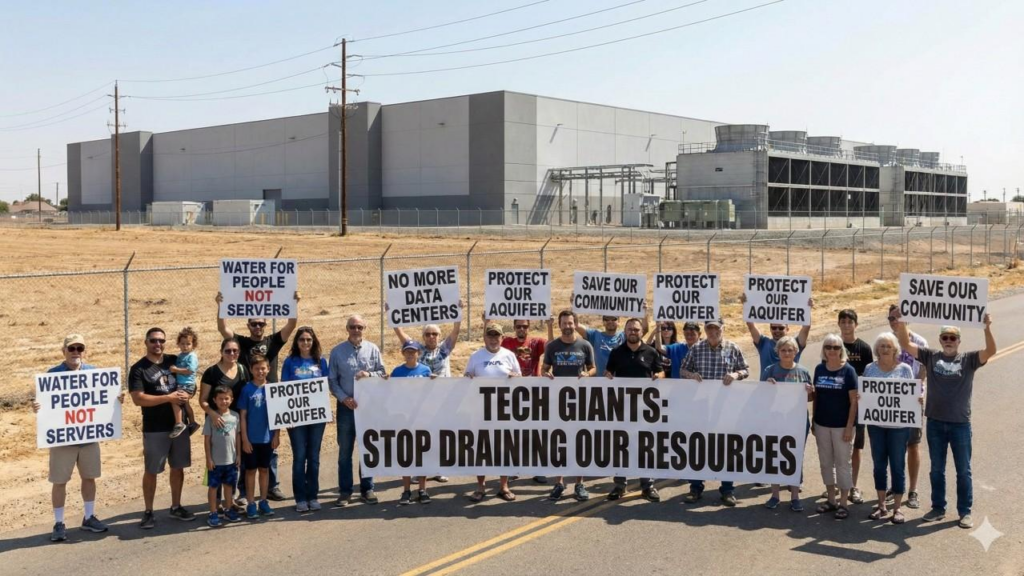
Displacement in this context does not look like forced eviction. It looks like paperwork.
Property values rise due to industrial demand, increasing taxes for long-time residents. Roads are widened to accommodate heavy equipment, bringing noise and traffic. Zoning changes allow expansion into areas once reserved for housing or agriculture. Insurance premiums rise in zones classified as industrial corridors. Some families sell voluntarily because staying becomes financially exhausting. Others leave because the character of the place no longer resembles where they intended to live.
At no point does anyone issue an order saying people must leave. The environment simply becomes more accommodating to the facility than to the community.
This is displacement by priority.
When Algorithms Begin to Decide
As artificial intelligence becomes integrated into grid management, water distribution, and traffic optimization, another layer of abstraction emerges. Resource allocation decisions that were once political and visible become computational and opaque. An algorithm balancing grid stability may decide which districts experience brief outages based on efficiency metrics that do not account for social vulnerability. A water management system may prioritize flows to facilities classified as critical infrastructure without recognizing that the surrounding community is under restriction.
The decisions are technically correct within the parameters they were given.
The parameters, however, were written to protect the system.
,,,,(sections not included)
Conclusion — The Sound Beneath Everything
The hum that residents hear near these installations is easy to ignore because it is constant. But constancy is how priorities become invisible. It is how hierarchies change without announcement. It is how systems grow powerful enough that questioning them begins to feel irrational.
Genocide and democide teach that catastrophic harm does not begin with obvious violence. It begins when people quietly become secondary to something considered more important than they are.
The expansion of AI infrastructure presents a moment where societies must decide whether computation will remain a tool for human flourishing or evolve into a structure whose needs can override the very people it was meant to serve.
If that decision is postponed, it will not be made in a dramatic public debate. It will be made slowly, through contracts, policies, and automated systems, until one day communities realize that the most powerful presence in their lives is a windowless building that never sleeps, never speaks, and never turns off.
And by then, the hierarchy will already be set.
ADVERTISEMENTS

Categories: Community Activism, Contributors