


John Marra, Mayor of Timberlake
October 21, 2026
Ohio Keeps Violating Its Constitution — And Property
Owners Keep Paying the Price
By John Marra, Mayor of Timberlake
How many times must Ohio’s courts tell our state government that its education policies are unconstitutional before our elected officials finally listen?
On October 15, the Ohio Tenth District Court of Appeals ruled that Ohio’s EdChoice voucher program is unconstitutional. Once again, the state has been told that its education policies violate the Ohio Constitution.
But this story began nearly 30 years ago.
In 1997, the Ohio Supreme Court ruled in DeRolph v. State that Ohio’s school funding system violated Article VI, Section 2 of the Ohio Constitution, requiring a “thorough and efficient system of common schools throughout the state.”
The fundamental problem was excessive reliance on local property taxes to fund education.
Nearly three decades later, that dependence remains.
Ohio’s property tax crisis is not simply a taxation problem. It is the consequence of decades of failing to correct a fundamentally flawed school funding system.
There is an old saying: When someone tells one lie, another often follows to cover up the first.
Ohio’s education policies have followed a similar pattern. Rather than correcting the original constitutional failure, lawmakers keep creating additional funding formulas, tax adjustments, voucher programs and political justifications to sustain a system that should have been fundamentally reformed decades ago.
One bad decision leads to another, and taxpayers keep paying.
According to Ohio’s Legislative Service Commission, school districts levied approximately $14.94 billion in property taxes in 2024, including $13.16 billion for operating expenses.
In many communities, approximately two-thirds of homeowners’ property taxes support schools.
Imagine removing that burden entirely.
A homeowner paying $6,000 annually could potentially see that bill reduced to approximately $2,000. Someone paying $9,000 could see a reduction to roughly $3,000.
The property tax crisis as we know it could largely disappear.
Schools would no longer depend on local property wealth or continually seek additional operating levies. Every student could receive equitable statewide funding regardless of ZIP code.
Ohio could also address another expensive problem: approximately 611 separate public school districts.
Do we need hundreds of separate superintendents, treasurers, administrative offices and overlapping bureaucracies?
Statewide funding could support sensible consolidation, shared administration and greater efficiency without necessarily closing neighborhood schools.
Less unnecessary bureaucracy. More resources for classrooms.
Now consider vouchers. Instead of first ensuring that every public school is adequately funded, Ohio expanded taxpayer-funded private-school vouchers.
The appellate court found that the current EdChoice system violates Ohio’s constitutional requirements by financing a competing private-school system without comparable public-school obligations. The decision is stayed pending appeal.
Parents deserve educational choices. But shouldn’t Ohio first fulfill its constitutional
responsibility to provide excellent public schools for every child?
Had lawmakers properly funded and reformed public education decades ago, much of the justification for today’s voucher expansion might never have existed.
And what about the billions Ohio spends on private-school vouchers?
If Ohio eliminated school property taxes and properly funded public education, families choosing private schools could apply their annual property tax savings toward tuition. Those savings would continue year after year rather than depend on a government voucher program.
Parents would retain the freedom to choose private education, while taxpayers would no longer be required to finance an expanding parallel system through vouchers.
Why should Ohio continue subsidizing private-school tuition while homeowners struggle to pay the property taxes supporting public schools?
Redirecting voucher expenditures toward a fair statewide public-school funding system could be another part of the solution, provided the state accounts for students who return to public schools and their educational costs.
And where would the replacement money come from?
Start with the enormous revenues Ohio already receives and the billions it voluntarily forgoes through tax exemptions, credits, abatements and preferential treatment.
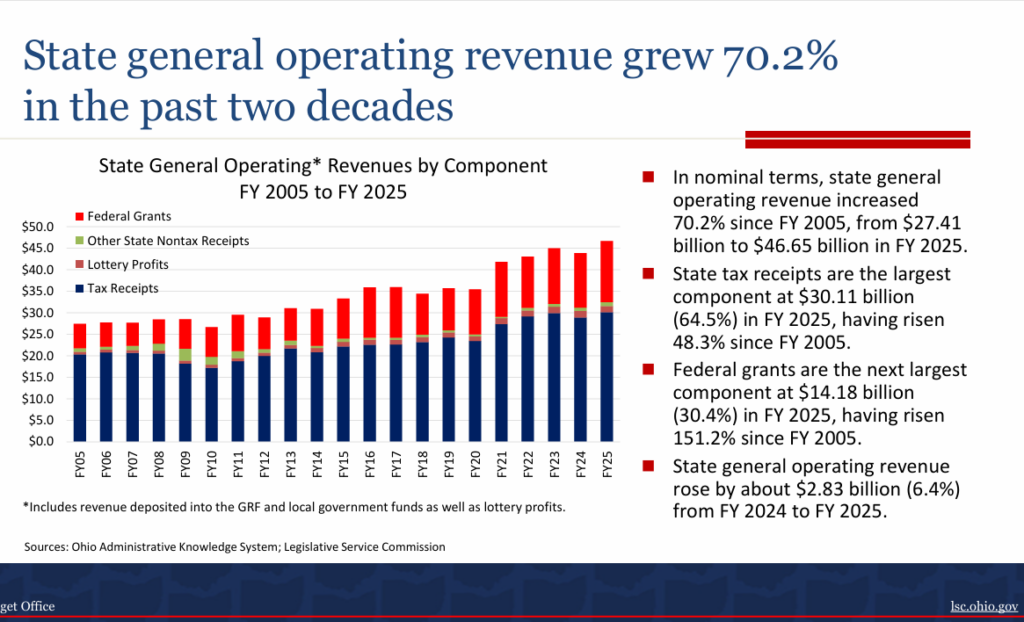
Ohio’s all-funds spending approached $105 billion in fiscal year 2025. According to the Buckeye Institute, state spending increased more than 50% over seven years.
But here is the question lawmakers should answer: Are we determining what government actually needs to spend, or are we building spending plans around the revenues government expects to receive?
The state forecasts its revenues, establishes spending priorities and appropriates billions accordingly. Yet homeowners continue receiving enormous school property tax bills on top of the taxes they already pay.
Why isn’t constitutionally required public education funded first, before discretionary programs, corporate subsidies and special tax preferences?
Instead of repeatedly asking taxpayers for more, Ohio should reverse its budgeting priorities: fund constitutional obligations and essential services first, eliminate unjustified spending and tax preferences, and return the resulting savings to taxpayers.
Review corporate tax breaks, eliminate unjustified subsidies, reduce waste and consolidate unnecessary administration. Redirect available resources toward constitutional responsibilities.
Not every budget dollar is unrestricted, and replacing property taxes requires a sustainable funding plan. But the first solution should be reprioritizing the taxes we already pay, not automatically collecting more.
Our tax dollars are already being collected. The question is whether government is putting them toward the right priorities.
And schools are only part of the problem. Police, fire protection, emergency services, roads and other essential services also require dependable funding.
That is why we must abolish property taxes entirely and fundamentally restructure how we finance schools and essential government services.
Government funding should not depend on an ever-increasing financial claim against our homes.
DeRolph did not specifically mandate abolishing school property taxes. But it exposed a constitutional failure Ohio has never adequately resolved.
Stop creating new problems to compensate for old failures. Follow the Constitution. Restructure government funding. Eliminate unnecessary spending. Give property owners their financial freedom back.
That is real property tax reform — nearly 30 years overdue.
Home ownership is the foundation of freedom and liberty.
Learn more about the proposed constitutional amendment to abolish Ohio property taxes and how to become a petition circulator at www.axohtax.com.


Categories: Community Activism, Lake County - General, Real Estate Taxes, Uncategorized