

By Brian Massie, A Watchman on the Wall
Joe Miller’s and Kent Kuholiski’s Ohio Political News podcast had a very informative show on the AI data centers being built in Ohio. Guest speaker is Melissa Wade from Trumbull County and the segment starts at the 1hour mark.
Thanks to Lake County patriot, Jim Weber, for sending us the following links about existing data centers in Ohio.
https://www.datacenters.com/locations/united-states/ohio
Since we knew that we would never get answers to our questions about data centers from our elected officials, we decided to ask Chat GPT. Here is the AI answer to why data centers are flocking to Ohio.
Data centers are in Ohio for several practical, economic, and strategic reasons. Here are the main ones:
- Geographic Advantage
- Low natural risk: Ohio has fewer earthquakes, hurricanes, and wildfires than many other regions. That stability makes it ideal for housing critical infrastructure.
- Central location: Being within a one-day of over half the U.S. population helps with logistics and network distribution.
- Cool Climate Reduces Costs
- Data centers generate massive heat
- Ohio’s cooler average temperatures allow companies to use outside air for part of the year, lowering cooling and energy costs.
- Abundant and Affordable Power
- Data centers require enormous amounts of electricity.
- Ohio offers relatively low electricity rates and access to multiple types of energy sources (natural gas, expanding renewables, nuclear in some regions).
- Strong Fiber and Network Infrastructure
- Ohio has invested heavily for regions where they can easily plug into high-capacity internet infrastructure.
- Business Incentives
- Ohio offers tax incentives, abatements, and grants for data-center development.
- Local governments often negotiate deals to attract long-term business investments.
- Available Land and Zoning
- Data centers need large parcels of land, distance from residential areas and proper zoning.
- Ohio provides relatively plentiful and affordable land suitable for these large facilities.
- Workforce and Educational Ecosystem
- The state has strong engineering, tech, and trade programs feeding into a trained workforce for construction, maintenance, and IT operations.
- Proximity to Major Corporations
- Companies like Google, Amazon, Meta and others are expanding operations in the Midwest.
- Ohio sits at the crossroads of many corporate supply chains and logistics networks.
We then asked AI how many jobs are created with a new data center?
A new data center creates far fewer permanent jobs than most people expect, but it creates a lot of temporary construction jobs. Here’s a typical breakdown:
- Construction Jobs (Temporary)
- A major data-center project commonly generates:
- 300 – 1,000 construction jobs that last 12 – 36 months depending on project size.
- Includes electricians, steelworkers, concrete crews, HVAC specialists, fiber installers, etc.
- Large hyperscale sties (Amazon, Google, Meta) often require $500M – $1B+ in construction, which supports a big labor force during the buildout.
- Permanent Jobs (Ongoing)
- After construction, a typical modern data center employs 25 – 100 permanent employees/
- Smaller cloud / enterprise centers have 15 – 30 jobs
- Large hyperscale sites have 50 – 100 jobs, including IT technicians, Network engineers, Security staff, Facility operations (cooling, power management)
- Logistics and administrative roles
- Why so few employees?
- Data centers are highly automated. A billion-dollar building with millions of servers needs surprisingly little staff once operational.
- Indirect / Induced Jobs (Not direct employees of the data center)
- Economic studies often claim that an additional 100 – 300 indirect jobs are also created in: Local contractors, Maintenance vendors, Power utilities, Food service, hospitality, retail and transportation.
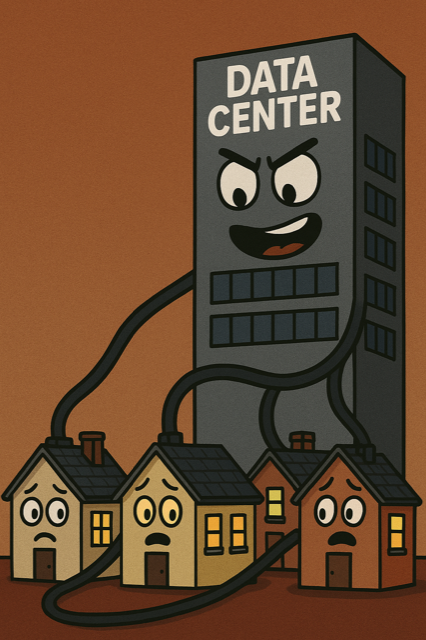
After reading the AI response, our question is why are our politicians allowing data centers into the state of Ohio? (over 200 to date) We provide them with tax breaks in sales tax, and property taxes and Ohio citizens will experience higher utility costs, break-downs in access to electricity and higher property taxes because of the higher land values caused by mega-corporation paying more than market value for the land.
The introduction of smart meters by the utility companies will ensure control of residential and commercial usage of electricity.
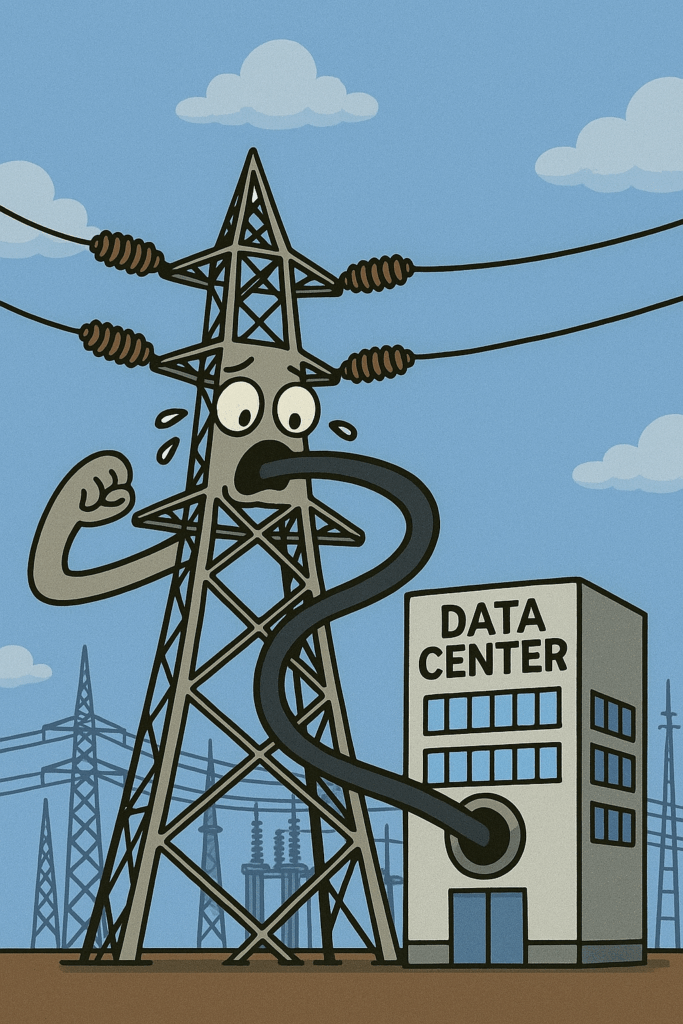
Data Centers are a very bad deal for the citizens of Ohio.
Not surprisingly, Ohio politicians are not even thinking about the plight of the average citizen in this State.
Advertisements


Categories: Community Activism, State of Ohio, Uncategorized