
Updated with comment: February 9, 2026
By Brian Massie, A Watchman on the Wall
A common refrain we hear from citizens against abolishing property taxes is that we must save the libraries and our parks. My unspoken reply is usually: “So you will give up your home for a book and a walk in the park?” I would like to address Lake County’s and Ohio’s library system in this article.
In Lake County, there are 8 public library systems operating at least 13 physical locations. Across the state, Ohio has 251 public library systems with approximately 732 to 777 total outlets, including branches and bookmobiles.
Libraries in Lake County
The county is served by several independent systems and one multi-branch school district library:
- Willoughby-Eastlake Public Library: 4 locations (Eastlake, Willoughby, Willoughby Hills, and Willowick).
- Mentor Public Library: 4 locations (Main Library, Mentor-on-the-Lake, Headlands, and The Hub).
- Fairport Harbor Public Library.
- Kirtland Public Library.
- Madison Public Library.
- Morley Library (Painesville).
- Perry Public Library.
- Wickliffe Public Library.
Lake County libraries receive approximately $7 million to $8.2 million annually in state funding from the Public Library Fund (PLF). However, this revenue is currently decreasing due to a 2025 change in the state’s funding model. As of July 1, 2025, Ohio shifted from a percentage-based funding system (1.7% of the state’s General Revenue Fund) to a fixed line-item appropriation, resulting in a statewide reduction of roughly $25 million for fiscal year 2026.
Individual Library Revenue (State Distribution)
While the final 2026 distributions for every branch are still being finalized under the new line-item model, recent state audit data and budget reports indicate the following approximate annual state revenue for major Lake County systems:
- Mentor Public Library: Approximately $2,220,287 (based on 2024–2025 actuals).
- Willoughby-Eastlake Public Library: Approximately $2,051,922 (based on most recent audit data).
- Wickliffe Public Library: Approximately $863,782.
- Morley Library (Painesville): State funding typically provides a significant portion of its general fund, which was estimated at $1,266,758 for the 2026 fiscal year.
Statewide Funding Outlook
The state of Ohio has allocated specific total amounts for all 251 library systems under the new budget (House Bill 96):
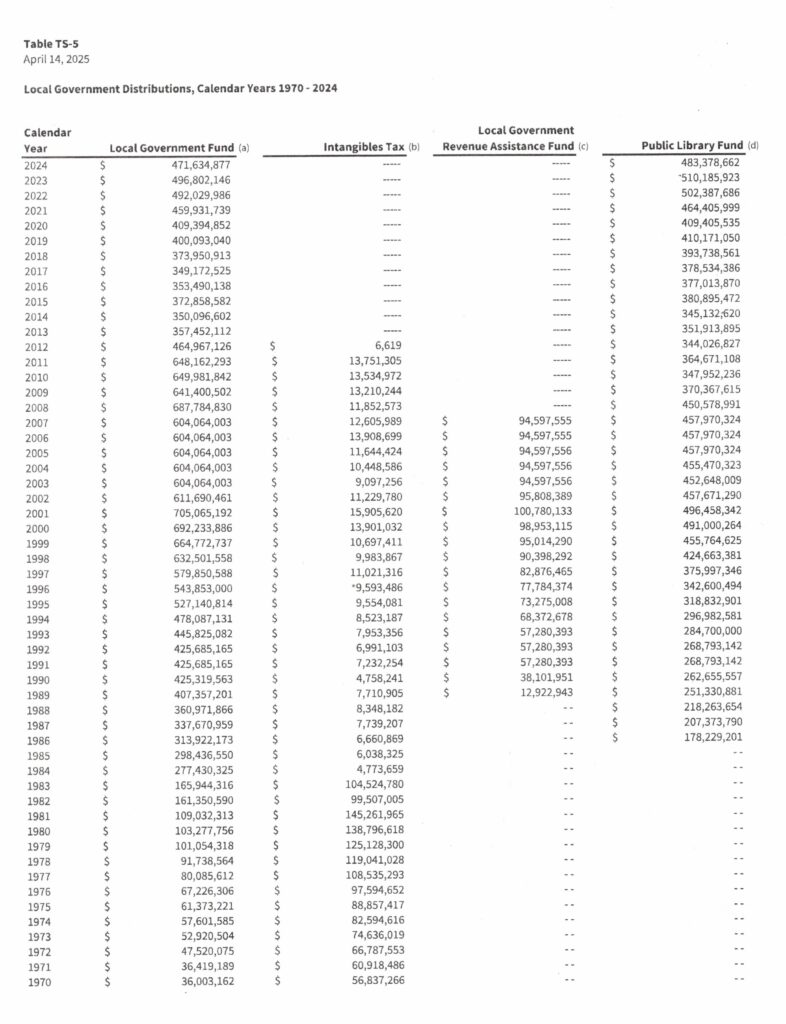
Since 2015 the State’s Public Library Fund has received greater revenue than the Local Government Fund that is sent to the local communities to pay for fire, police and roads in the community. The State has prioritized public libraries over the local safety forces.
Key Insights
- Funding Split: For most Lake County libraries, state funds (PLF) account for roughly 35% to 57% of their total operating budgets, with the remainder coming from local property tax levies.
- The “Line-Item” Shift: The change to fixed line-item funding in 2026 means library revenue will no longer automatically increase when state tax revenues grow, making local levies even more critical for maintaining services.
- Local Support: In November 2025, Lake County voters showed strong support for their libraries, with systems like Willoughby-Eastlake successfully renewing 2-mill levies to offset state stagnation.
In 2026, Ohio’s state funding for public libraries is diverging from its traditional parallel with local government funding. Historically, both the Public Library Fund (PLF) and the Local Government Fund (LGF) were tied to a percentage of state tax revenue. However, as of July 1, 2025, the state budget (House Bill 96) decoupled library funding from this model, shifting it to a fixed “line-item” appropriation while maintaining the percentage-based model for local governments.
Funding Comparison: 2025–2026
Under the 2026–2027 biennial budget, the funding trajectories for these two groups are as follows:
| Fund | 2025 (Actual) | 2026 (Appropriated/Est.) | Year-over-Year Change |
|---|---|---|---|
| Public Library Fund (PLF) | $504.6 Million | $479.7 Million | -4.9% (Reduction) |
| Local Government Fund (LGF) | $535.4 Million | $556.3 Million (Est.) | +3.9% (Growth) |
Key Structural Differences
- The “Line-Item” Shift for Libraries: Libraries no longer benefit from automatic revenue growth. While the state appropriated $490 million for the PLF in 2026.
After reviewing these numbers we now understand why our libraries are “taj mahals”.
It is also very clear that the state government is not sharing their tremendous increase in revenue with the local governments. This requires local taxing authorities to rely on local property taxes and income taxes to pay for local services.
We can foresee public libraries trying to pass more property tax levies. It begs the following questions:
- Are libraries still needed?
- Does Lake County and Ohio need as many libraries as we have? Can there be a consolidation of libraries in each county?
- Can the libraries be funded locally with an annual subscription fee, (only those that use the library pay for using it), or must we accept the “warmth of socialism” in a “collective” society?
Collectivism means a social order in which the choices of the group, defined and enforced by the state, override individual choice, property rights, and voluntary payments for services. Karl Marx was the proponent of collectivism. Unfortunately, Ohio is run by socialists, and controlled by the special interest lobbyists.
Individual rights and freedom are waning in the State of Ohio. New leadership is needed to return us to our founding principles.
Updated February 9, 2026

Linda Goudsmit / February 8, 2026
Pundicity page: goudsmit.pundicity.com
and website: lindagoudsmit.com
I am a businesswoman and always follow the money, so your explanations are particularly helpful to me. Understanding the gestalt of the funding makes the information applicable to other cities and libraries facing the same funding/taxing considerations around the country.
Regarding libraries, I look at them from the perspective of your question: Are libraries still needed? Sadly, it is my opinion that in 10 years there will be no more libraries as we know them today. I have come to this painful conclusion by two routes: publishing and public usage. Publishing royalties paid to authors are staggeringly higher for ebooks (electronic/digital books) than for hardback or paperback formats. This cash incentive explains why so many books today are not even published in hardback or paperback formats.Why the cash incentive? What is the political purpose of digital books? For me, it is clear that the enemies of freedom want all information disseminated electronically because it is so simple to control the information electronically––one click of a mouse changes everything!! And it is already happening. Classics are being reformatted in form (hard copies to electronic) and content altered (revisionism)!!!
Young people use their devices to access information––all electronically. They get their news on their cell phones. They read bedtime stories to their children on screens. Change happens slowly––then all at once. We are fast approaching the all at once phase when books, films, documents, etc. etc. etc. will only be available electronically––for our convenience of course. IMHO libraries will be indefensible from an underutilization/economic standpoint––they will be transformed into data centers where all books, films, documents will be streamed into homes. Additionally, an argument can be made that libraries are currently dominated by radical leftist staffing, and books purchased by library systems are overwhelmingly radical leftist indoctrination in content. So what is the great loss? Whoever controls the information controls society. So, wresting control of libraries is parallel to wresting control of education from the radical, leftist, progressive Democrat party seeking to dismantle and destroy our constitutional republic. Everything is political, and everything is connected Brian. Sad but true
ADVERTISEMENTS


Categories: Community Activism, State of Ohio, Uncategorized