

Brian Massie, Average Citizen
A Watchman on the Wall
We found this article from cleveland.com to be very informative.
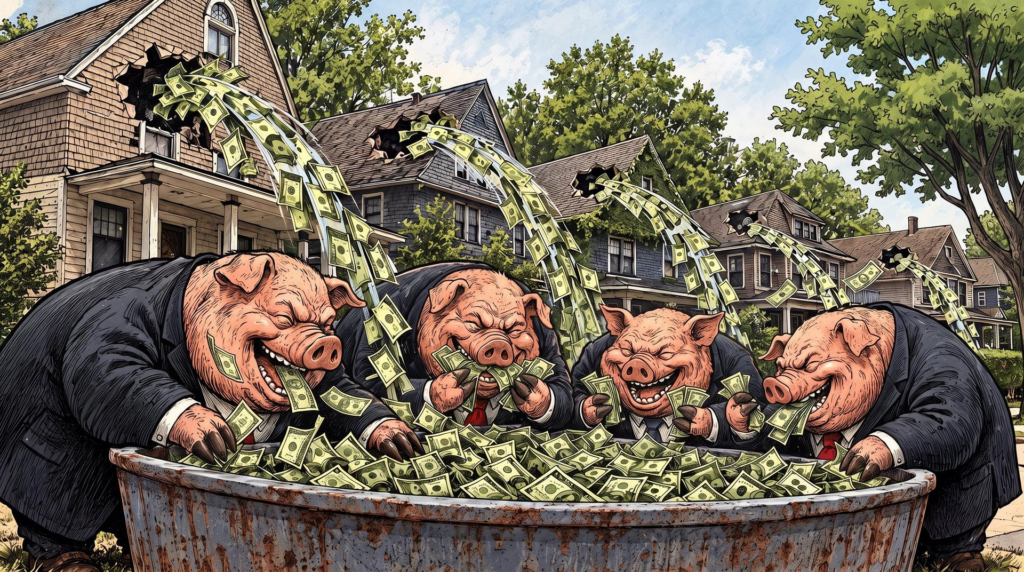
Illustration created with AI tools
One of our newsroom’s biggest challenges in 2026 is explaining a topic whose very name makes you want to stop reading:
Tax-increment financing.
But keep reading. It’s costing you money. And it is about to cost you a lot more.
Our challenge is making it understandable and accurate when elected officials describe it in complex, messy terms to deter your interest. And, quite frankly, when we keep repeating their fiction. We are complicit, as I’ll explain.
Tax-increment financing is not complicated. My goal today is to show you why — and to sound the alarm. You’re the victim of a costly, long-running con game. You still have time to stop it.
Fundamental Principle Number 1
Property taxes are based on the idea that everyone pays a fair share of the cost of shared services, based on the value of their property.
Of course, we corrupted that idea by exempting nonprofits. The Cleveland Clinic, for example, has property worth billions but doesn’t pay property taxes. Nor do University Hospitals or MetroHealth. Churches, charities, colleges. None pay. And then we started abating taxes to spur development. Abated property pays nothing for years.
Set those exemptions aside for a moment. Our first principle is that property taxes were intended to spread the cost of shared services fairly.
Fundamental Principle Number 2
Tax-increment financing began nobly decades ago to help distressed neighborhoods like those in Cleveland and East Cleveland. Developers struggled to get full financing for projects in such risky areas.
The solution: Take the increase in property taxes generated by new development and put that money back into the projects to complete their financing. Those taxes would not go to schools, parks, libraries and county social services, but the arrangement would spark investment where it was needed.
Tax-increment financing was used sparingly for decades, largely as intended. Its use has exploded recently.
Here’s where the government fiction comes in. Government and agency leaders regularly say those diverted taxes cost their agencies tens of millions of dollars. They trot out this claim when they ask you to approve more taxes. It’s part of how they cry poor.
It is nonsense. It’s costing those agencies almost nothing.
But it is costing you, the homeowner or small business owner.
When a government seeks more money from taxpayers, as Cuyahoga County just did for health and human services, it uses simple math.
First, it adds up the revenue it expects over the next few years. Existing taxes, fees, fines. Whatever. That produces one number.
Then it forecasts what it will spend during those years. That’s the second number.
The difference is the third number: the amount it asks you and me to provide through a new tax.
Here’s the key: It calculates the tax rate needed to raise that amount based solely on the properties where taxes pay for the agency or government. The calculation accounts for nonprofit exemptions, tax abatements and the taxes diverted through – yes — tax-increment financing.
You see that? The government sets the rate knowing those diverted taxes won’t help pay the bill. It asks the rest of us to cover it.
That gives us Fundamental Principle Number 2: When voters approve the tax, the government gets the amount it asked for.
Without tax-increment financing, taxes on that new development would help pay the bill, and the tax rate for all of us would be lower. The government would collect exactly the same amount — what it originally calculated it needed.
The real losers are you and me. Our rate is higher because we’re covering the share those developments would otherwise pay.
Here’s where I acknowledge our complicity. We have repeatedly reported taxing agencies’ claims about the millions they “lose” to tax-increment financing, without explaining who really pays. I can’t count how many times we’ve done that.
That’s on us. I’m sorry. We’ll do better.
Fundamental Principle Number 3
If that were the whole story, our reporting challenge would be manageable.
But the story has become far more sinister.
Municipal leaders throughout Cuyahoga County — largely Democrats — have vastly expanded their use of tax-increment financing. They’re using it to steal away the taxes from development for themselves. They are loading it into their budgets, giving them more cash to squander.
I argue Cleveland started this. It created a tax-increment financing district for all of downtown, directing the increased taxes from new development into the city’s pocketbook. Those taxes won’t help pay for county services, even though Cleveland is the biggest beneficiary of those services. Cleveland schools still get their money through an exception.
We could be talking about billions of dollars in development.
Then Cleveland created another district covering a big chunk of the East Side.
What do you think happened next?
Suburban leaders saw what Cleveland was doing and figured they might as well follow suit. Why let taxes from their new development pay for county services if Cleveland was keeping its money?
The most craven move is in Orange, where a big housing development is underway without having sought a tax-increment financing deal. The mayor nevertheless saw an opportunity to load the village budget with cash and proposed two districts.
But Orange residents understand that property taxes work only if everyone pays a fair share. Credit them for charging into council meetings to demand that the mayor stop his money grab. He is still pursuing it, but he and the council keep postponing public hearings, hoping the outrage abates.
Meanwhile, Cleveland Heights, where I live, has four tax-increment financing districts on the table. Others keep popping up.
The floodgates are open. Are we approaching a point where no new development in this county helps pay for county services? If so, homeowners will bear a hugely disproportionate share of the cost.
Eventually, that unfairness will sink in, and I believe voters will stop supporting property taxes. Why vote yes when elected officials are skimming huge amounts and leaving you to make up the difference?
Fundamental Principle Number 3 is this: Every new tax-increment financing district that gets approved means a higher tax rate for you on the next tax.
You and I subsidize those districts. If we end up with hundreds, we’ll be paying a lot.
Be forewarned. The people who profit from these districts and the Democratic leaders creating them will try to bamboozle you. They will say I’ve oversimplified the issue. They will throw around jargon to make this seem complex.
When they do, keep the three fundamental principles in mind:
Property taxes are supposed to spread the burden fairly.
Taxing agencies calculate what they need and ask us to pay it. When they claim to “lose” millions to these districts, they lie, You and I are the ones who lose.
Every new district shifts more of that burden onto the rest of us.
| Copy this column. Put it in a folder. Every time an elected leader tells you a tax-increment financing district is good for you, read it again. And share it.If homeowners do not demand an end to this obscene greed, I predict our system for funding government will collapse. It’s time to demand fiscal restraint from our leaders.We are surrounded by pigs at the trough.And we keep feeding them.I’m at cquinn@cleveland.comThanks for reading |
 |

Chris Quinn
Editor and Vice President of Content
cleveland.com / The Plain Dealer
Editorial comments by Brian Massie, Average Citizen
ANY TAX CAUSING A CITIZEN TO BECOME HOMELESS IS IMMORAL.
If citizens keep voting for any property taxes, they are funding their own demise.
We need to cut government spending at all levels.
ADVERTISEMENTS

Categories: Community Activism, Contributors, Real Estate Taxes, Uncategorized